
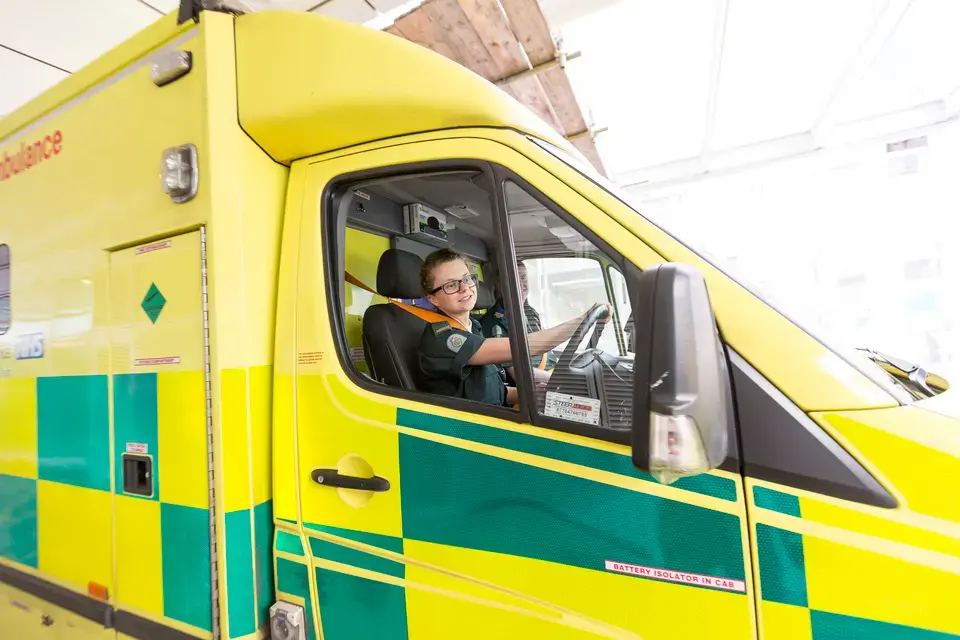
The FutureQuals CERAD™ Qualification is the nationally recognised qualification for Emergency Response Ambulance Drivers
The most widely accepted Emergency Response Ambulance Driving Qualification by HSC and NHS Ambulance Trusts, private and voluntary ambulance service providers and the Driver Training Advisory Group (DTAG)
About the Course
CERAD™ is the term used by many people to refer to Emergency Response Ambulance Driving, but it is important to note that there are different qualifications by two different awarding organisations FutureQuals and Qualsafe Awards
This FutureQuals Level 3 Certificate in Emergency Response Ambulance Driving is the most widely recognised and accepted emergency response driving qualification for Pre-Hospital professionals with a responsibility to respond, such as Emergency Care Assistants (ECA), Emergency Medical Technicians (EMT), Associate Ambulance Practitioner (AAP) or HCPC Paramedic in the NHS and private sectors.
Aimed at people who will be dispatched by an Ambulance Trust Emergency Operations Centre (Ambulance 999 control room) or those clinical staff providing ambulance services providing event medical services that have the risk of needing to transport patients so as not to put pressure on NHS ambulance resources for private events.
This qualification has 3 different pathways based on the vehicle type that the learner will be required to drive as part of their role.
Course Entry Requirements:
Learners are required to evidence the following before they can be accepted on to the course:
- Be 18 years of age (or older) (21 if using our vehicle)
- Hold a valid driving licence for the category of vehicle being driven the full duration of the qualification
- Learners with any pending or actual points, endorsements or driving convictions should speak to us first
- Learners must have a contract (or job offer) with an Ambulance Service (NHS/HSC or Private) that CQC regulated (or equivalent)
Learners are not required to have any formal qualifications in literacy or numeracy; however as a Level 3 Certificate qualification – learners will be expected to demonstrate an adequate level of written English (comparable to an a-level academic standard)
Learners are also expected to have access to a laptop and have basic IT skills as we use Microsoft Office 365 to facilitate elements of the course, course material and host your portfolio which you are required to complete.
Course Summary
- Regulated Qualification (Awarded by FutureQuals)
- 120 Guided Learning Hours (GLH)
- 150 hours Total Qualification Time (TQT)
- Non-Expiring Certificate
- Course Costs from £2999 + VAT
Pay a deposit to join the next course
Course delivery
Full Time
3 Weeks (plus an induction day)
Monday – Friday
Mixture of classroom and practical driving.
Part Time
5 weekends (plus an induction)
Friday Evening – Online Live Theory (Teams)
Saturday & Sunday Practical Driving.
How the Course is assessed
When registering for your course, you will be provided with course material and textbooks. You have 3 Knowledge based assignments to complete that centre around
- Incident Management
- Vehicle Characteristics and Comparisons
- Human factors
These are provided before your course, and completed as early as possible in the course to allow you to focus on other assessment areas.
3 Online MCQ Exams spaced through out the course
- Traffic Signs, Signals & Markings (MCQ 1)
- Theory before on road training at speed (MCQ 2)
- Legislation, Roadcraft and The Highway Code Assessment (MCQ 3)
These are conducted throughout the course, generally on
Full Time Courses
- MCQ 1 - (from) Day 4
- MCQ 2 - (from) Day 7
- MCQ 3 - (before) last day
Part-Time Courses
- MCQ 1 - Weekend 2
- MCQ 2 - Weekend 3
- MCQ 3 - Weekend 4
Throughout the course you will have opportunity to practice the skills delivered in theory sessions and live demonstrations; where your facilitator will demonstrate procedures on various associated tasks involved in the ambulance driver role. You are then expected to demonstrate these un-assisted, whilst your facilitator observes.
These include:
- Vehicle Daily Inspections (VDI)
- Pre-Driving Checks (PDC)
- Reversing & Manoeuvring
- ERD Re-Prioritisation
- Navigation exercises
- Driving during the hours of darkness
Throughout your course you will have two driving assessments, one observed by your facilitator and one independently assessed.
Routine Driving Assessment
This is conducted by your facilitator and you are required to pass this assessment before you are able to progress on to the emergency response phase of the course.
Emergency Response Driving Assessment
This final driving assessment is conducted by an independent assessor as your final driving assessment. It lasts approximately one hour across varying road types and situations; where you get to demonstrate to an independent assessor your abilities in emergency response driving. Much like a DVSA driving test, they may also ask questions to confirm your knowledge.